
You know, in the vast, bustling video game ecosystem of 2026, where every other indie game claims inspiration from the same handful of sacred cows, I find a perverse delight in the weird, niche obsessions. It’s like finding out your favorite Michelin-starred chef’s secret ingredient is a specific brand of gas station jerky. For me, Hollow Knight isn’t just a masterpiece; it’s a monument to one of gaming’s most divisive oddballs: Zelda II: The Adventure of Link. While the world has been collectively holding its breath for Silksong, I’ve been diving back into this rabbit hole, and let me tell you, the connection is weirder and more wonderful than you might think.
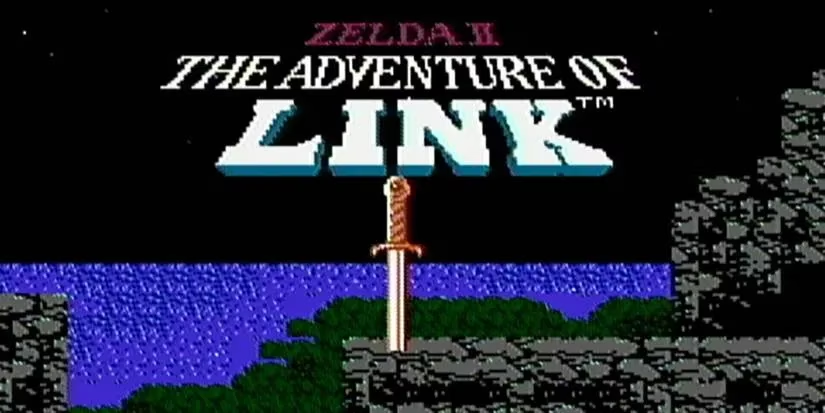
Let’s set the scene. The year is 2026. We’ve had games that simulate the entire lifecycle of a star, but I’m still here, marveling at how a quirky 8-bit experiment from the 80s became the spiritual glue for Team Cherry. According to their old Kickstarter page—which I revisit like a sacred text—Zelda 2 is name-dropped three times. It’s listed alongside Metroid and the wonderfully obscure Faxanadu as a style inspiration. But the real kicker? Co-director William Pellen’s gaming origin story hinges on a moment where "his Dad found the wing boots for him in Zelda 2." Can you imagine? Not saving the princess, not pulling the Master Sword, but finding the wing boots. That’s the kind of specific, granular magic that forges a lifelong passion. The most telling line, though, is this: "Our team initially formed around game jams, but we really bonded over our love for Zelda 2." In a sea of developers who worship at the altars of Super Metroid or Symphony of the Night, bonding over Zelda 2 is like three people meeting at a party and discovering they all have an encyclopedic knowledge of 18th-century nautical knots. It’s beautifully, wonderfully strange.
Now, I know what you’re thinking. Zelda 2? The black sheep? The one that’s often to the Zelda series what a spork is to cutlery—functional, but confusing to purists? 😅 Its side-scrolling, RPG-lite, brutally difficult departure was about as far from the top-down adventure of the original as you could get. Asking someone to rank their Zelda games today is like asking them to rank their children, and Zelda 2 is often the kid who decided to become a professional mime. Yet, in a 2018 interview that only saw the light of day in 2025, Pellen and animator Ari Gibson spilled the beans on why this odd duck was so crucial. They argued it offered something the Metroidvania greats didn’t: a specific sense of a populated vastness.
Gibson described it as "not being able to feel the edges" of the world. Think about that. In an NES game, with its technical limitations, the world felt boundless not because you could see forever, but because your imagination had to fill in the gaps. The cryptic clues, the hidden towns, the sheer mystery of what lay beyond the next screen—it created a sense of scale that was more psychological than graphical. It was a world built on implication, like hearing a fantastic story told in whispers from the next room. This wasn’t just nostalgia talking; this was a design philosophy they wanted to bottle.
And bottle it they did. Playing Hollow Knight in 2026, its brilliance in capturing this feeling is still staggering. Unfolding its map is a ritual of simultaneous dread and delight.
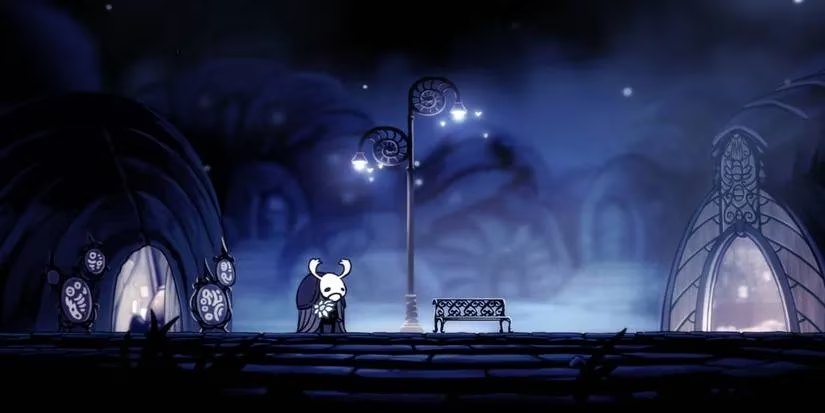
The gorgeous, hand-drawn art uses soft focus and deep backgrounds to constantly hint at a world stretching far beyond your 2D plane. Those little specks of life—the melancholic Elderbug, the slyly humorous Zote—they puncture the overwhelming loneliness with warmth, just like the quirky townsfolk in any Zelda game. But the core of the connection is that feeling of the unknown. Pellen and Gibson nailed it in their interview with a fractured sentence that says everything: Pellen: "Like, legitimately not knowing..." Gibson: "...what you're going into." That hesitation on the precipice, the delicious terror of dropping into a new area, is Hollow Knight’s heartbeat. It’s a feeling as rare and precious as a perfectly preserved vinyl record in a streaming world, and they learned it from Zelda 2.
So, while we all wait for Silksong with the patience of a saint watching paint dry, I’ve gained a new appreciation for this lineage. Hollow Knight’s success isn’t just about tight controls or beautiful art. It’s about channeling the spirit of a game that dared to be different, that embraced its own weird rhythm. Loving Zelda 2 in 2026 is an act of quiet rebellion against homogenized design. It’s recognizing that sometimes, the most profound inspiration comes not from the universally praised masterpiece, but from the flawed, fascinating experiment that taught a few developers how to make players feel truly, wonderfully lost. And when I finally step into Pharloom, that sense of boundless, unknowable wonder will be my constant companion, a direct inheritance from an 8-bit adventure that never quite fit in.
Comments